RSS

Proceed at your own risk.

Proceed at your own risk.

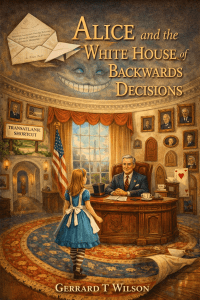
AUTHOR’S NOTE: The Invisible Architecture

The story you are about to read is not a fantasy. It is an autopsy.

When Lewis Carroll wrote Alice’s Adventures in Wonderland in 1865, he was satirizing the rigid, nonsensical logic of Victorian education and law. He used a rabbit hole to show how a child’s innocence is swallowed by the arbitrary rules of adulthood.

In our modern era, we do not fall through holes in the earth. We descend through pixels.

“The Terms of Service” is an allegory for the year we are currently living in—a time when the “elites” are no longer just people in high offices, but the very algorithms they have unleashed. We find ourselves in a world where “Truth” has been replaced by “Engagement,” where “Citizens” have been downgraded to “Users,” and where our most private thoughts are harvested like raw ore to power a machine that never sleeps.

This story is intended to hold no punches. It explores the uncomfortable reality that our modern “Wonderland” is not a prison forced upon us by a cabal of geniuses. Instead, it is a gilded cage we have built for ourselves, one convenient click at a time. The institutions we fear—the media, the tech giants, the financial structures—are merely mirrors reflecting our own collective desire for distraction over depth and safety over sovereignty.

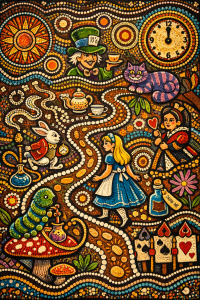
As you follow Alicia through the Institutional Layers of New Ouroboros, I invite you to look closely at the “Slang” in the Appendix and the “Friction” in the Tea Party. Ask yourself:

When was the last time I looked away from the screen long enough to see the sky in its own color, rather than the shade I was told to expect?

The Queen is waiting. The Rabbit is glitching. And the Terms of Service are non-negotiable.

Proceed at your own risk. Click HERE to read the full story


Tags: , , , , ,

Tullow Pyramid

Tullow Pyramid

The morning mist in Tullow usually smells of damp grass and the Slaney river, but on a Tuesday in October, it carried the scent of sun-baked cedar and ozone.

When the sun finally burned through the fog, the townspeople found it: a pyramid, no taller than a two-story townhouse, sitting perfectly centered in the middle of The Square. It hadn’t made a sound. No one’s Ring doorbell had captured a delivery truck, and the gravel beneath it hadn’t even been displaced. It looked as though it had been there for ten thousand years, and the town of Tullow had simply grown around it overnight.

The Impossible Stone

The structure wasn’t gold or limestone. It was made of a deep, matte basalt that seemed to “drink” the light around it. Local historian Sean O’Shea was the first to approach it with a magnifying glass.

“It’s not Egyptian,” he whispered to the huddle of onlookers. “The carvings… they’re Ogham, but they’re wrong. The lines are moving.”

He was right. The deep grooves etched into the stone weren’t static. If you looked at a symbol and then blinked, the notches had shifted, crawling like slow-motion insects across the surface of the dark stone.


The “Goings-On”

As the day progressed, the “mysteries” escalated from architectural anomalies to full-blown local phenomena:

  • The Weightless Zone: Within ten feet of the pyramid, gravity seemed to lose its grip. Local kids discovered they could jump six feet into the air with a single hop. A stray Border Collie was seen drifting three feet off the ground, looking mildly annoyed as it paddled through the air.
  • The Radio Silence: Every digital device in Tullow began to act up. Car radios played music that hadn’t been recorded yet—melodies with instruments that sounded like glass breaking in harmony. Phone screens showed maps of stars that didn’t exist in the Milky Way.
  • The Echoes of the Past: At noon, the air around the pyramid grew thick. People standing near the Post Office reported seeing “shadows” of people in ancient robes walking through the walls of the modern shops. They weren’t ghosts; they looked solid, but they were silent, focused on a city that had stood in Tullow’s place eons ago.

The Door Without a Seam

By sunset, the Irish Defense Forces had cordoned off the area, but the pyramid had its own ideas about security. A seam appeared on the eastern face—not a door opening, but the stone simply evaporating into a fine purple mist.

A low hum, like a thousand bees vibrating in a cello case, began to pulse through the pavement. Those standing closest reported a sudden, overwhelming memory of a life they had never lived—a memory of a Great Library and a sky with three moons.

“It isn’t a tomb,” Sean O’Shea shouted over the rising hum as the military tried to push the crowd back. “It’s a bookmark! It’s holding our place in time!”

As the clock struck midnight, exactly twenty-four hours after its arrival, the pyramid didn’t vanish. Instead, the colors of Tullow began to bleed into it. The gray pavement turned to gold dust; the local pub’s neon sign turned into a floating orb of cold fire. The pyramid wasn’t visiting Tullow—it was starting to rewrite it.


The Morning After

The next day, the pyramid was gone. The Square was empty. But the people of Tullow were different. Everyone in town now spoke a second language—a melodic, ancient tongue they all understood but couldn’t name. And in the center of the Square, where the pyramid had sat, the grass now grows in the shape of a perfect, unblinking eye.


The transition from a sleepy market town to a high-security “Linguistic Quarantine Zone” happened in less than seventy-two hours.

The Irish Defense Forces were replaced by international suits: UN observers, cryptographers from Fort Meade, and stone-faced men in lab coats. They set up a perimeter around Tullow, but they weren’t looking for radiation or biological weapons. They were looking for words.

The Incident at Murphy’s Hardware

It started small. Mrs. Gately, a grandmother of seven, was trying to explain to a scientist that she felt “perfectly fine.” But as she spoke the new melodic tongue—the Tullow Tongue—she reached for a word that sounded like ‘Lir-un-teth’.

As the syllable left her lips, the air in the room didn’t just vibrate; it crystallized. Every loose nail and bolt in Murphy’s Hardware rose from its bin, suspended in mid-air, forming a perfect, rotating sphere of jagged metal. When she stopped speaking out of shock, the metal fell, clattering to the floor like a thousand spilled coins.

The scientists stopped taking notes. They started taking measurements.


The Architecture of Sound

The townspeople soon realized that their new language was actually a User Interface for the Universe.

Phrase (Phonetic) Observed Effect
Vora-shé Localized gravity increases by 15%; footsteps feel like lead.
Kael-o-min Objects become transparent for exactly sixty seconds.
Thu-lar-is Temperature drops to freezing point within a three-meter radius.
 
Leave a comment

Posted by on December 19, 2025 in time travel


Tags: , , , ,

The Silver Needle

The Silver Needle

The Silver Needle

The North Wind did not blow; it exhaled, a long, shivering breath that flattened the dead grass of the meadow. Then came the Quiet.

I arrived in the lungs of the night. I am the Frost, the silent architect, the silver needle that sews the world shut.

I began at the edge of the pond. I am not like the Snow, who is heavy and loud, smothering the earth under a white wool blanket. I am delicate. I moved across the surface of the water, knitting a skin of glass so thin that the fish below looked up and saw a sky made of diamonds.

I climbed the stalks of the sleeping hemlock. I turned the spider’s web—a discarded, messy thing—into a lace veil fit for a ghost. I moved with a mathematician’s precision, tracing the jagged rim of every fallen oak leaf, outlining their veins in crushed pearls.

I found a discarded iron spade leaning against a stone wall. To the humans, it was rust and cold metal. To me, it was a canvas. I grew a forest of ferns across its blade, silver fronds that would never see the sun, for the sun is my executioner.

Near the Haroldstown stones, I found a small wooden birdhouse, empty and forgotten. I did not enter. Instead, I feathered the roof with a thousand tiny daggers of ice, pointing toward the stars.

The world was now a museum of stillness. No twig snapped. No breath was drawn. I had turned the unruly, muddy earth into a kingdom of crystal geometry. I sat upon the world, cold and perfect, waiting for the first grey light of the dawn to turn my silver into gold, knowing that as soon as I was most beautiful, I would vanish.

I am the ghost of the water. I am the memory of the cold. And for one night, I held the earth perfectly still.


Tags: , , , ,

The Echo of the Dolmen

The Echo of the Dolmen

The air above Haroldstown Dolmen on Christmas Eve was thick with the kind of ancient magic that hummed just beneath the surface of Ballykillduff. It wasn’t the boisterous, unpredictable magic of sentient sausages, but a quieter, deeper power, woven into the very stones themselves. The three massive granite capstones, perched precariously atop their six supporting uprights, looked like a giant’s forgotten Christmas table, dusted with a fine layer of frost.

Young Aoife, a girl whose imagination was as wild and untamed as the gorse bushes on the surrounding hills, was convinced the Dolmen was a portal. Not to another dimension, perhaps, but to another time. Every Christmas Eve, armed with a thermos of lukewarm tea and a pocketful of slightly squashed shortbread, she’d trek up to the ancient burial site, hoping for a glimpse of… something.

This year, however, was different. As the last sliver of the setting sun dipped below the horizon, painting the sky in hues of bruised purple and fiery orange, a strange light began to emanate from beneath the Dolmen. It wasn’t the cold, ethereal glow of faerie lights, but a warm, pulsating amber, like a forgotten hearth fire.

Aoife, shivering more from anticipation than cold, crept closer. The air around the stones grew surprisingly warm, smelling faintly of woodsmoke and something sweet, like honey and frankincense. As she peered into the dark crevice beneath the capstone, she saw not darkness, but a swirling, golden mist.

Suddenly, a voice, deep and resonant, yet as gentle as a lullaby, drifted from the mist. “Welcome, child. You have come at the turning of the year, when the veil is thinnest.”

Aoife gasped, dropping her shortbread. “Who… who are you?”

From the swirling light emerged not a spectral figure, but a kindly old man with eyes as bright as winter stars and a beard that cascaded like freshly fallen snow. He wore robes woven from what looked like spun moonlight, adorned with intricate patterns that shimmered with forgotten symbols.

“I am the Spirit of the Dolmen,” he replied, a warm smile crinkling the corners of his eyes. “Or perhaps, the echo of all who have celebrated the turning of the light here, since before memory.”

He gestured to the mist, and it parted, revealing a breathtaking scene. It wasn’t Ballykillduff as she knew it. Instead, she saw a circle of ancient people, bundled in furs, gathered around a roaring fire beneath the very same Dolmen. They weren’t celebrating Christmas as she knew it, but rather the Winter Solstice, sharing stories, feasting on roasted meat, and offering thanks to the sky.

Then the scene shifted. She saw Roman soldiers, their helmets glinting, leaving offerings of coins and wine at the base of the stones, their voices hushed with respect. Later, she saw early Christian monks, their solemn chants blending with the whisper of the wind, blessing the ancient site. And in every scene, spanning centuries, there was the same profound sense of gathering, of hope, of light returning in the darkest days.

“This place,” the Spirit explained, his voice weaving through the visions, “has always been a place of gathering, of hope, of welcoming the light. Every celebration, every prayer, every shared meal has left its mark, echoing through these stones.”

The visions faded, and Aoife found herself back in the present, the golden glow dimming, the cold air returning. The Spirit of the Dolmen stood before her, a gentle smile still on his face.

“Christmas, child,” he said, “is but the latest song sung in this ancient choir. The message remains the same: gather, hope, welcome the light.” He reached into his luminous robes and produced a small, smooth pebble, glowing faintly with the amber light. “A token. Remember the echoes.”

As the last flicker of light faded, the Spirit of the Dolmen dissolved back into the stones, leaving only the biting cold and the quiet majesty of the ancient monument. Aoife clutched the warm pebble in her hand, feeling a profound connection to all the Christmases, all the Solstices, all the gatherings that had ever taken place beneath those silent, watchful stones.

She trudged home through the frost, the pebble a comforting warmth in her pocket. This Christmas, she realized, she wouldn’t just be celebrating with her family; she’d be celebrating with the echoes of centuries, with the Spirit of the Dolmen, and with the timeless magic that bound Ballykillduff to its ancient past. And as she curled up in her bed, she could almost hear the faint, distant hum of generations, singing a lullaby of hope under the watchful eyes of the old stones.

Aoife trudged home through the biting frost, her fingers wrapped tightly around the glowing amber pebble. Her heart was full; she felt she had witnessed the very heartbeat of history. The Spirit had shown her that Christmas was just one layer of a much older story of light and hope.

As she entered her house, the smell of cinnamon and roasting turkey greeted her. Her parents were in the kitchen, laughing and clinking glasses.

“There you are, Aoife!” her father called out. “We were starting to think the pooka had snatched you away. Did you see anything interesting at the stones?”

Aoife smiled, her thumb stroking the smooth surface of the gift in her pocket. “Just the wind and the stars, Dad,” she said, keeping her secret safe.

She went upstairs to her room and placed the pebble on her windowsill. It cast a soft, golden light across her wallpaper, illuminating her old books and toys. Exhausted by the magic of the evening, she fell into a deep, dreamless sleep.

On Christmas morning, Aoife was woken not by the sound of bells, but by a heavy, rhythmic thudding coming from outside. She ran to the window, expecting to see a neighbor’s tractor or perhaps a stray cow from Farmer Giles’s field.

But the village of Ballykillduff was gone.

In its place stood a vast, prehistoric forest of towering oaks and dense ferns. The air was thick and humid, smelling of damp earth and ancient moss.

Terrified, she looked down at her windowsill. The amber pebble was no longer glowing; it was now a dull, grey piece of granite. Beside it sat her modern smartphone, but the screen was dead, showing a “No Signal” icon that flickered strangely.

She looked back out at the horizon where the Haroldstown Dolmen stood. It wasn’t a ruin anymore. It was brand new, the stones sharp and clean, surrounded by hundreds of people dressed in furs, their faces painted with blue woad. They weren’t “echoes” or “visions”—they were real, breathing, and looking directly toward her window with expressions of profound confusion.

One of the men stepped forward, holding a spear. In his other hand, he held an identical amber pebble. He held it up toward her, and as the morning sun hit it, the stone began to pulse.

Aoife realized then that the Spirit hadn’t shown her a portal to the past. He had made her the “echo.” She wasn’t a girl in 2025 dreaming of the ancient world; she was now the ancient mystery that the people of the Dolmen would spend the next five thousand years trying to explain.


Leave a comment

Posted by on December 19, 2025 in dolmen, haroldstown


Tags: , , , ,

A Ballykillduff Extermination (Of the Blues)

A Ballykillduff Extermination (Of the Blues)

Deep in the heart of Ballykillduff, where the tea is strong and the Daleks have replaced their death rays with tinsel, comes a festive greeting just for you.

A Ballykillduff Extermination (Of the Blues)

“Listen here now, humans of the parish! It is I, Dalek O’Shea, and I have a formal announcement before the Angelus rings.

We have scanned the perimeter of the creamery and found no trace of bad luck. Therefore, by order of the Supreme Council (and Father Murphy), you are all sentenced to a Grand Ould Time.


The Festive Mandate

  • EXTERMINATE the dry turkey!
  • CELEBRATE with a decent drop of Jameson!
  • REGENERATE after the third helping of pudding!
  • INFILTRATE the neighbor’s house for a quick gossip and a mince pie!

“You will sit by the fire. You will watch the Late Late Show. You will enjoy yourselves… OR BE EXTERMINATED! (But only after we finish this plate of sandwiches.)”


The Wish

May your chimney be wide enough for a Dalek in a Santa hat, may your cows stay milked, and may your Christmas be more powerful than a Sub-Etheric Transmitter.

Nollaig Shona Duit—EXTERMINATE! EXTERMINATE! EXTERMINATE!


Tags: , , , ,

Alice and the Wild Boar of Wonderland

Alice and the Wild Boar of Wonderland

Alice and the Wild Boar of Wonderland:

The Director’s Cut (Now With 300% More Chaos)

Alice had returned to Wonderland for one reason: nostalgia. Big mistake.

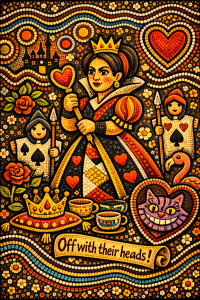
The place had gone full corporate dystopia. The White Rabbit was now a crypto bro shilling “CarrotCoin,” the Mad Hatter ran an NFT tea party where every cup was a unique digital collectible worth exactly nothing, and the Queen of Hearts had rebranded as an influencer with the handle @OffWithTheirHeads69.

Worst of all, the Cheshire Cat had launched “GrinR,” Wonderland’s premier ride-sharing app. Slogan: “We vanish when you need us most.”

Alice tapped the app. Destination: Home.

Vehicle arriving: “Kevin the Boar – 4.9 stars (deducted 0.1 for chronic truffle addiction).”

Kevin arrived looking like a warthog that had lost a bet with a taxidermist. He wore a tiny saddle, a Bluetooth earpiece, and an expression that screamed, “I went to boar school for this?”

Alice climbed on. Kevin immediately side-eyed a glowing mushroom.

“Don’t even think about it,” Alice warned.

Kevin thought about it. Hard.

The ride began politely, past teacup gardens, under rainbow toadstools, until Kevin spotted the Holy Grail of truffles: a massive, glistening beauty sprouting right in the middle of the Queen’s private croquet lawn.

Kevin floored it.

“KEVIN, NO!” Alice screamed, clutching his mane as they bulldozed through a hedge maze like it was made of tissue paper.

Card soldiers dove left and right. One guard yelled, “License and registration!” only to be flattened into the shape of the two of clubs.

They skidded onto the croquet field just as the Queen was about to execute a flamingo for “unsportsmanlike squawking.”

Kevin launched himself at the truffle like a furry missile, uprooted it, and inhaled it in one obscene slurp. Then he let out a belch so powerful it parted the Queen’s wig, revealing a tattoo that read “Live, Laugh, Lob.”

The entire court froze.

The Queen’s face turned the color of a ripe tomato having a stroke.

“OFF WITH HIS TROTTERS!” she shrieked.

Alice, panicking, did the only thing she could think of: she pulled out her phone and fake-reviewed on the spot.

“Your Majesty, please! Kevin has 4.9 stars! He’s verified! He accepts tips in acorns!”

The Queen paused, mallet raised. “Reviews?”

Alice nodded frantically. “Read them yourself! ‘Best ride ever, 10/10 would be stampeded again.’ ‘Kevin took a shortcut through a caterpillar’s hookah lounge, legendary.’ ‘Only complaint: he ate my picnic.’”

Kevin, sensing an opportunity, turned on the charm. He sat. He gave paw. He even attempted a smile, which looked like a constipated bulldog discovering taxes.

The Queen lowered her mallet. “Fine. But he’s banned from my lawn. And someone get this pig a breath mint.”

As they trotted away, the Cheshire Cat materialized on Kevin’s head like a smug helmet.

“Not bad for a rookie driver,” he purred. “Next fare’s the Dormouse, he tips in half-eaten crumpets.”

Alice groaned. “Just get me out of here.”

Kevin suddenly braked. In the path ahead: a single, perfect truffle.

Alice glared. “Kevin. I swear to Lewis Carroll.”

Kevin looked back at her with big, innocent eyes.

Then he winked.

And floored it again.

Somewhere in the distance, the Queen’s scream echoed: “OFF WITH ALL OF THEM!”

Alice clung on for dear life, laughing in spite of herself.

Wonderland, it seemed, was exactly as mad as ever, just with worse customer service.


Tags: , , , ,

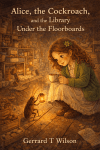
Alice and the Places That Think: Ballykillduff Wonderland

Alice and the Places That Think: Ballykillduff Wonderland

Prologue

Alice decided later that the most troubling part was not the sheep.

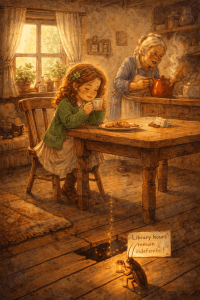
The sheep was troubling, certainly. It stood in the middle of the lane with the quiet confidence of something that knew it had always been there and always would be. Its wool was the colour of old clouds, its eyes were thoughtful, and around its neck hung a small wooden sign that read:

BACK SOON

Alice read it twice.

“I don’t think that’s how sheep work,” she said politely.

The sheep regarded her in silence, chewing in a manner that suggested deep consideration of the matter. Then it turned, quite deliberately, and began to walk away down the lane.

“Excuse me,” Alice called. “I think you’ve dropped your…”

The sheep did not stop.

Alice hesitated. She had been taught very firmly never to follow strange animals, especially those displaying written notices. But the lane itself seemed to lean after the sheep, curving gently, as if it preferred that direction. Even the hedges appeared to listen.

With a sigh that felt far older than she was, Alice followed.

The lane led her into Ballykillduff.

At least, that was what the sign said. It stood crookedly at the edge of the village, its letters faded and patched over, as though someone had changed their mind halfway through spelling it. Beneath the name, in much smaller writing, was a second line:

Population: Yes

Alice frowned.

The village looked entirely ordinary, which in her experience was often a bad sign. Stone cottages huddled together as if exchanging secrets. A postbox leaned sideways in what might have been exhaustion. Somewhere, a clock was ticking very loudly and very wrongly.

The sheep paused beside the postbox.

It did not look back. It did not need to.

The postbox cleared its throat.

“Letter?” it asked.

Alice jumped.

“I—no,” she said. “I mean, not yet.”

“Take your time,” said the postbox kindly. “We’ve plenty of it. Too much, if you ask me. It keeps piling up.”

The sheep nodded.

“I’m sorry,” Alice said carefully, “but could you tell me where I am?”

The postbox considered this. “Well now,” it said, “that depends. Where do you think you ought to be?”

“I don’t know,” Alice admitted.

“Ah,” said the postbox, sounding relieved. “Then you’re exactly right.”

The sheep turned at last and met Alice’s eyes. For a moment she had the strange feeling that it recognised her.

Then the ground beneath her boots gave a polite little sigh and began to sink.

Alice did not scream. She had learned by now that screaming rarely helped.

Instead, as Ballykillduff folded itself carefully over her like a story closing its covers, she wondered whether anyone at home would notice she was gone.

The sheep watched until she vanished completely.

Then it picked up its sign, turned it around, and hung it back around its neck.

BACK AGAIN.


Chapter One

In Which Alice Arrives Properly, Though Not Entirely on Purpose

Alice discovered that falling into Ballykillduff was not at all like falling into a hole.

There was no rushing wind, no spinning cupboards, no floating bookshelves or jars of marmalade. Instead, there was the distinct sensation of being lowered, as though the ground itself were doing its best to be polite about the whole affair.

The earth sighed again, thoughtfully, and then stopped.

Alice found herself standing upright on a narrow stone path, her boots perfectly clean, her hair only slightly rumpled, and her sense of direction completely missing.

Above her was a sky that could not quite decide what time it was. Clouds hovered in pale layers, some tinged with early morning pink, others sulking in late afternoon grey. A sun of modest ambition shone through the middle, as if unwilling to commit itself fully.

Ahead lay Ballykillduff.

Up close, it was even more ordinary than before. That, Alice felt, was the problem.

A row of cottages leaned together in a way that suggested ongoing conversation. Their windows blinked slowly, like eyes that had just woken up. Smoke curled from chimneys without any particular urgency, drifting sideways and then upwards as though reconsidering.

Alice took one careful step forward.

Nothing happened.

She took another.

Still nothing.

“Well,” she said to herself, “that is either very reassuring or extremely suspicious.”

A man appeared from nowhere in particular, which is to say he stepped out from behind a low stone wall that Alice was quite certain had not been there a moment earlier.

He was tall, thin, and wrapped in a long coat that had known many weathers and disagreed with all of them. In his hand he carried a pocket watch, which he examined with great seriousness.

He did not look at Alice.

“Oh dear,” he muttered. “Not yet. Definitely not yet.”

“Excuse me,” Alice said.

The man startled so badly that he nearly dropped the watch, which he caught just in time and then scolded.

“You shouldn’t do that,” he said to Alice. “Appearing suddenly.”

“I didn’t,” Alice replied. “You did.”

He considered this.

“Well,” he said at last, “we’ll call it a draw.”

He finally looked at her, his eyes sharp and kind and far too alert for someone who seemed permanently behind schedule.

“You’re early,” he said.

“Am I?” Alice asked.

“Oh yes,” he said firmly. “Or late. One of the two. We get very upset if people arrive exactly when they mean to.”

“What is your name?” Alice asked.

“Seamus Fitzgerald,” he said, consulting his watch again. “At least, that’s what it says here. And you are Alice.”

Alice blinked. “How do you know that?”

Seamus smiled apologetically. “You’ve been expected.”

“I have only just arrived,” Alice said.

“Yes,” Seamus agreed. “That’s what I mean.”

Before Alice could ask anything else, a bell rang.

It was not a loud bell, nor an urgent one. It sounded as though it had rung many times before and had learned not to get worked up about it.

Seamus gasped.

“Oh dear,” he said. “That will be Bridget.”

“Who is Bridget?” Alice asked.

Seamus was already walking away.

“You’ll see,” he said over his shoulder. “Everybody does.”

Alice followed him into the village.

As she did, she noticed that the houses were watching her now, not rudely, but with the quiet interest one might show a guest who had arrived without luggage and clearly intended to stay.

Somewhere behind her, the sheep coughed.

Alice did not turn around.

She had a feeling that once you began turning around in Ballykillduff, you might never stop.

And that, she suspected, was how the village liked it.

To read the rest of this story, click HERE – and enjoy


Tags: , , ,

Alice and the Winter Wonderland.

Alice and the Winter Wonderland.

Alice and the Winter Wonderland.

Alice had not meant to follow the White Rabbit again.
She had promised herself, after the trial of the Knave of Hearts, after the croquet madness and the endless tea party, that she would stay firmly on the sensible side of looking-glasses and rabbit holes.
But it was Christmas Eve, and the snow had fallen so thickly that the world outside her window looked like one of Dinah’s half-finished dreams. A single lantern glowed in the garden, and beneath it hopped a small white figure in a scarlet waistcoat, brushing snow from his whiskers and consulting a pocket watch that chimed like tiny bells.
“Oh dear, oh dear, I shall be too late for the Queen’s carol!” he muttered.
Alice sighed, pulled on her blue coat (the one that matched her favorite dress), and stepped into the night.
The rabbit hole was exactly where she remembered it, hidden behind the old oak, but tonight it was lined with frost and strung with colored glass ornaments that swayed like fruit on invisible branches. Down she slid, not tumbling this time, but gliding gently, as though the air itself had turned to soft feathers.
She landed in snow up to her ankles.
The Wonderland she stepped into was not the bright, feverish place of her childhood. It was hushed and silver-blue, every hedge dusted white, every path paved with checkered ice that gleamed like the hallway floor of a grand, frozen palace. Lanterns hung from bare branches, casting pools of golden light, and from somewhere far off came the sound of bells and laughter.
The White Rabbit was already hurrying away, his ears tipped with frost. “This way, Alice! Her Majesty is expecting guests!”
Alice followed, her boots crunching softly. The trees grew taller and stranger: pines decorated not with tinsel but with teacups and playing cards frozen mid-flight. A dormouse snoozed inside a hanging ornament, curled around a thimble of hot cocoa. Snowflakes drifted down, large, perfect, and oddly deliberate, as though someone had cut them from paper with tiny scissors.
They came at last to a clearing where the Queen of Hearts had erected an enormous Christmas tree. It rose higher than any tree Alice had ever seen, its branches heavy with crimson baubles, golden crowns, and hearts made of ruby glass. At its base sat the Queen herself, no longer shouting “Off with their heads!” but humming a carol while directing a troop of playing-card soldiers as they hung the last ornaments.
The Queen spotted Alice and beamed, an expression so unfamiliar that Alice almost didn’t recognize her.
“There you are, child! We’ve been waiting. No croquet today. Only singing, and presents, and far too much plum pudding.”
The Mad Hatter arrived next, wearing a top hat trimmed with holly. The March Hare carried a tray of steaming teacups that smelled of cinnamon and pepper. Even the Cheshire Cat appeared, grinning from a branch, his stripes flickering like candlelight.
They sang, first awkwardly, then with growing joy. The cards formed a choir, their voices thin and papery but sweet. The Dormouse woke long enough to join in a sleepy alto. Snow kept falling, soft and endless, turning the clearing into a shaken snow globe.
Later, when the singing was done and the pudding eaten, the Queen pressed a small gift into Alice’s hands: a single red ornament shaped like a heart, warm to the touch.
“For remembering,” the Queen said quietly. “Even queens grow lonely sometimes.”
Alice looked around at the glowing lanterns, the decorated trees, the strange friends who had once terrified her and now felt like family. Wonderland, for one night, had chosen peace over madness.
When it was time to go, the White Rabbit led her back to the frosted rabbit hole. He bowed, a little shyly.
“Merry Christmas, Alice.”
“And to you,” she said.
She climbed upward through the soft dark, the heart-ornament tucked safely in her pocket. When she emerged into her own garden, the snow had stopped. The lantern still glowed, but the White Rabbit was gone.
Alice hung the red heart on her own small Christmas tree that night. And every year after, when the snow fell thickly and the lanterns shone, she thought she heard faint bells from somewhere below the roots of the old oak, inviting her, gently, to come again.
But she was older now, and Wonderland, she suspected, had learned to celebrate Christmas quite nicely without her.
Still, she always left an extra teacup by the fire.
Just in case.
 

Tags: , , ,

The Gift That Didn’t Fit

Chapter One: The Immediate Chaos

The air in the Quince living room was thick with the suffocating scent of fresh pine and manufactured guilt. It was 11:37 PM on Christmas Eve, and sixteen-year-old Lily Quince was perched on the edge of the sofa, trying to ignore the dazzling, high-wattage shame radiating from the pile of wrapped goods under the tree.

“Honestly, Mom, why does a human being need a self-stirring cocoa mug?” Lily muttered, batting a stray, metallic ribbon off the sofa cushion and onto the carpet. “It’s exactly what’s wrong with Christmas. Too much stuff.”

Her little brother, Sam, only eight, nodded solemnly, his brow furrowed with devastating sincerity. He was crouched by the fireplace, sketching feverishly in a notebook. “That’s what I keep trying to tell Santa, Lily. We need effort, not expenditure.” He looked up, his eyes shining with pure, tragic longing. “I just hope he remembered the Woven Basket of Live Earthworms this year. I truly don’t know how I’ll run my pet farm without them.”

“You’ll be yearning for a ceramic garden gnome that plays the lute by morning.”

Lily froze, her hand hovering near the tin. “Did… did the shortbread just talk?”

“Was that about the worms?” Sam asked, looking hopeful.

Lily shook her head, feeling a cold dread replace her cynicism. Outside, the first flakes of snow began to fall, but the typical, cozy feeling of Christmas Eve was absent. Something felt fundamentally wrong with the world. Across the street, they heard the distinct sound of Mr. Henderson, the CEO, weeping inconsolably about his lack of a custom-made tuba.

The Silent Night is Loud

Lily slipped on her coat, unable to wait for morning. If the Shifter had affected the desires of the entire neighborhood, Christmas Day would be a disaster—or a surreal comedy show.

“I’m just getting some air,” she mumbled to Sam, who was now meticulously reviewing his notebook, listing the exact dimensions required for a thriving earthworm community.

The moment Lily stepped onto the porch, the magnitude of the problem hit her like a punch of frosted air. Usually, Christmas Eve was silent and respectful. Tonight, it was a discordant mess of frustration and absurd longing.

Mr. Henderson, usually an impeccably tailored man, was kneeling in his snow-dusted front yard, staring mournfully into an empty, expensive-looking violin case. “They didn’t listen!” he wailed to his terrified poodle. “They brought me a watch! I need the booming resonance! I need the tuba!”

Two doors down, Mrs. Petula, the neighborhood’s notorious gossip, was shrieking at her husband, clutching a gift-wrapped broomstick. “A stick, Gerald! You call this a gift? I explicitly asked for a custom-made chandelier constructed entirely of dried macaroni! My heart is broken!”

Lily pulled her hood tight. The Shifter hadn’t just changed what people wanted; it had filled the absence of that desired object with genuine, heart-wrenching disappointment. It was weaponized absurdity.

She rushed back inside, snatching the Chrono-Crumble Tin off the mantel. “Listen, you rusty, talking dessert container,” she whispered fiercely. “What did you do? And how do I turn you off?”

The grumpy butler voice sighed dramatically from inside the tin. “Oh, the drama! I simply adjusted expectations, young hero. And I am only deactivated by a truly Perfectly Thoughtful Gift. A transaction of the heart, not the wallet. Now, if you’ll excuse me, I need to observe the mailman lamenting his lack of a ceramic foot bath.”

Lily stared at the tin, then down at the gigantic pile of expensive, unwanted electronics destined for Sam. “A perfectly thoughtful gift,” she repeated. “Something that proves I know him.”

Suddenly, a memory sparked: the feeling of peeling away a piece of glow-in-the-dark putty—a tiny, molded star—from her mirror two Christmases ago. And a ridiculous, low-value object immediately sprang to mind: the Worry-A-Day Jar. A simple jar filled with 365 days of Sam’s cheesy jokes and encouraging observations. Lily had scoffed at it then. Now, it felt like the only non-absurd object left in the world.

“That’s it,” Lily whispered, ignoring the tin’s muffled giggling. “The jar. I have to find that jar.”


Chapter Two: The Search for the Sublime

Lily’s bedroom was a landscape of teenage archaeology, a place where sentimental objects went to be buried under layers of homework, fashion magazines, and forgotten technology. The room was the first place she looked for the Worry-A-Day Jar, and it instantly felt like searching for a needle in a haystack—a haystack that suddenly felt full of unwanted and cursed gifts.

She dug through her closet, shoving aside boxes of things she’d asked for but never really used. Under a pile of textbooks, she found a plastic, voice-activated diary she’d begged for last year. It beeped softly.

Diary: “My deepest desire is for a miniature, fully functioning, decorative garden hedge.”

Lily slammed the lid shut. The Shifter was still working its magic on things, too.

She pulled out her winter wear. There, tucked inside a ski boot, was the brightly colored, slightly misshapen Green and Purple Mitten that Sam had knitted two years ago—the one intended to replace the left mitten she always lost. She felt a pang of guilt, remembering how quickly she’d bought a professional black pair instead.

“A thoughtful gift,” Lily muttered, holding up the uneven wool. “This could have been it, except I tossed it aside.”

The Chrono-Crumble Tin, which she’d tucked under her arm like a mischievous football, offered a raspy chuckle. “Close, but no cigar. The magic requires perfect thoughtfulness, not near-perfect discardment. And besides,” the tin added with spite, “it’s nearly Christmas morning. You’re running out of time.”

A glance at her phone confirmed the tin’s warning: 1:15 AM.

Lily began tearing through her desk drawers, scattering papers, pens, and loose change. The desk was where the Jar belonged. Sam had presented it to her with such a proud, serious expression two years ago.

“It’s the Worry-A-Day Jar, Lily,” he had announced. “You open one slip when you’re worried. I filled it with things you need more than homework.”

Lily remembered politely putting it behind her laptop, deeming it too childish. She hadn’t even opened a week’s worth of slips. Now, the space was filled with charger cables and empty soda cans.

Frustration bubbling up, she accidentally kicked a box under her bed. It was a dusty container labeled “Old Toys.” She pulled it out, coughing in the dust cloud. The box contained all the childhood treasures she thought she had outgrown: old picture books, a handful of plastic dinosaurs, and—

Bingo.

Sitting nestled between a stuffed unicorn and a broken kaleidoscope was the Worry-A-Day Jar: a simple, painted mason jar, the lid wrapped with a glittery pipe cleaner, looking utterly out of place amidst the chaos of her teenage room.

Lily carefully lifted the jar. The hundreds of small, folded paper slips inside were the only thing that felt real and pure in the whole magical, ridiculous night.

“Okay, Shifter,” she whispered to the tin under her arm. “I have the tool. Tell me how to use it to reverse the spell.”

The Chrono-Crumble Tin cleared its metallic throat. “You must craft the desired gift—the earthworm basket—with an act of love so genuine that it proves you truly saw the recipient. The key is in the Jar, child. The key is in the words.”

Lily frowned. “The words? The terrible jokes and advice?”

“They are proof of his attention,” the Shifter corrected with a rare note of seriousness. “You need to read the slips, understand how he sees you, and reflect that sincerity back in your gift to him. Go now. The sun rises in four hours.”

Lily clutched the Jar and the Tin, the strange weight of the magical responsibility settling on her shoulders. She had to rush downstairs, read her brother’s heart, and then craft a perfectly thoughtful earthworm basket before the world woke up to the most disastrous, absurd Christmas morning in history.

Click HERE to read the rest of this story


Tags: , , , ,

The Diary of a Disgruntled Gargoyle

The Grumpy Grotesque’s Grand Getaway

Entry 1: Day 1,472,305 of Unappreciated Perch-dom

Another dawn. Another flock of pigeons mistaking my head for a public convenience. Honestly, if I wanted this much unsolicited avian attention, I’d have been carved as a bird feeder. Name’s Gary. I’m a gargoyle. A gargoyle, mind you, not a grotesque. There’s a difference. Gargoyles have a function – we spout water. Grotesques are merely decorative. I, however, have not spouted water in approximately 300 years, largely due to a blocked pipe that no one, not even the highly-paid “historical monument conservation team,” has bothered to fix. So, technically, I’m a grotesque with an identity crisis. And a perpetually damp chin.

My view? Dublin Castle. Grand, yes. Historically significant, undeniably. But after a million years of watching tourists take selfies with duck faces, and politicians entering with promises they’ll never keep, it all blends into one grey, drizzly monotony. My stone heart yearns for adventure. My calcified buttocks ache for a change of scenery.

Entry 2: The Escape Plan – Operation: Wing It (Figuratively)

I’ve been observing the humans. They move. They go places. They use these contraptions called “buses” and “cars.” Fascinating. My initial thought was to simply sprout wings and fly, but alas, structural integrity issues. A gargoyle on the loose might cause a bit of a kerfuffle. No, subtlety is key. I’ll need a disguise.

My eyes, which admittedly haven’t blinked since the Normans were still fashionable, landed on a particularly lumpy, discarded bin bag at the castle gates. Eureka! A perfect, if slightly malodorous, cloak of invisibility. And perhaps a few strategically placed leaves for that “au naturel” look. My destination? The Cliffs of Moher. I overheard a tourist raving about the “majesty” and “untamed beauty.” Sounds far less stressful than guarding a castle from imaginary dragons and very real seagulls.

Entry 3: The Great Descent (More of a controlled tumble, really)

Getting down was… an experience. I waited for the darkest hour, and with a mighty heave, unmoored myself. Gravity, my old friend, took over. I bounced off a decorative flagpole (oops, sorry, King William!), slid down a drainpipe like a stone toboggan (surprisingly exhilarating!), and landed with a muffled thud in a rose bush. A nearby fox gave me a look that clearly said, “Are you serious right now?” I gave him my best gargoyle glare, which mostly just made him yawn.

Disguise on. Bin bag secured. I looked less like a mythical beast and more like a very confused pile of rubbish. Perfect.

Entry 4: The Bus Stop Blues

Finding the bus stop was easy; understanding the timetable was not. “Route 41 to Swords via the airport bypass”? What even is a Swords? I decided to trust my instincts, which, after centuries of static observation, were mostly telling me to stay put and complain. Eventually, a double-decker bus rumbled along. I squeezed myself aboard, attempting to look inconspicuous. The bus driver, a kindly man named Pat, glanced at me. “Bit early for Halloween, isn’t it, mate?” he chuckled, clearly mistaking me for a particularly unconvincing costume. I merely grunted, which he seemed to accept as a valid fare.

My fellow passengers were an interesting bunch. A woman knitting a jumper for a chihuahua, a teenager engrossed in a device that glowed, and an elderly gentleman who kept trying to offer me a biscuit. I politely declined, worried about crumbs getting lodged in my intricate stonework.

Entry 5: The Scenic Route (and the Seagull Incident)

The journey was glorious! Rolling green hills, quaint villages, and not a single pigeon in sight. I even saw a field full of sheep, none of whom looked particularly interested in mistaking me for a rock. My stone heart swelled. This was living!

Then, the seagull incident. We pulled over at a roadside diner, and I, eager for some fresh air (or as fresh as a gargoyle gets), hopped out. A particularly brazen seagull, clearly a veteran of chip-stealing, swooped down and attempted to make off with the bin bag that was my disguise. A tug-of-war ensued. Me, a centuries-old guardian of Dublin Castle, locked in a battle of wits and sheer stone mass against a feathered chip-fiend. I won, of course, but not before my bin bag was slightly tattered, revealing a hint of grey, moss-kissed stone underneath. The seagull squawked indignantly and flew off, probably to complain to its union.

Entry 6: Moher at Last!

And then, there they were. The Cliffs of Moher.

The Grumpy Grotesque’s Grand Getaway (Conclusion)

Entry 7: Moher at Last! (Continued)

And then, there they were. The Cliffs of Moher. Sheer, glorious, unadulterated rock. The air was sharp with salt, and the wind—oh, the wind was a roaring, magnificent beast that tugged at my remaining bin-bag remnants.

I found the perfect spot, perched precariously near the edge (a familiar feeling, really, just without a castle beneath me). I looked out over the vast Atlantic. The waves crashed against the base of the cliffs with a spectacular, deafening roar. It was raw, it was wild, and it was entirely unlike the polite, drizzly chaos of Dublin.

I closed my non-blinking stone eyes and took a deep, imaginary breath. This was the peace I craved.

My contemplation was abruptly shattered by a tiny, flustered puffin attempting to land on my head.

“Excuse me, mate! Are you new?” chirped the puffin, hopping down my shoulder. “This is Seamus’s viewing spot! He’s very territorial about his lichen patch.”

I sighed, a sound like grinding geological plates. “I am Gary, and I am merely seeking a moment of respite from the endless monotony of Dublin Castle.”

The puffin, unimpressed, pecked at my mossy ear. “Dublin Castle? Oh, a city boy! You won’t last five minutes. The sheer solitude will drive you mad, and the local folklore is very strict about unauthorized stone figures.”

Entry 8: Philosophical Conclusion and an Unforeseen Career Change

I spent the next hour in a profound, existential debate with the puffin named Seamus about the nature of eternal stillness versus migratory urgency. It was surprisingly enriching, though Seamus kept demanding I stop “hogging the good light.”

The wind, however, had a surprising effect. It whistled through the crevices in my old stone frame, creating an unexpectedly melodic sound. Tourists walking past stopped. They pointed. They took photos.

“Listen to that!” cried one tourist. “It sounds like a mournful Celtic wind chime! What a brilliant piece of natural art!”

Another leaned in close. “Look! They’ve carved a gargoyle here! It’s so authentic, it looks like it’s been guarding the sea for centuries!”

Suddenly, I wasn’t a disgruntled escapee; I was a majestic, windswept attraction. I was a Cliffs of Moher Grotesque, revered for my melancholic whistling.

I realized then that my problem wasn’t the job; it was the scenery. I was a mountain gargoyle trapped in a city gargoyle’s life.

Epilogue:

Gary never returned to Dublin Castle. He sent a curt, one-line message via a migrating pigeon: “Mending that drainpipe is your problem now.”

He now resides permanently on the Cliffs of Moher. He is locally famous, known as ‘The Whistling Sentinel of the West.’ He has a new job: official atmospheric sound effect for the Cliffs of Moher. He gets regular compliments, the occasional free picnic sandwich left by tourists, and his only co-worker is Seamus the Puffin, who still demands I move, but mostly just uses me as a very sturdy, slightly grumpy landmark.

And Gary? He’s finally happy. He’s found his purpose: standing still, looking magnificent, and complaining about the weather to the Atlantic Ocean, which, unlike the Castle, actually listens.

 
Leave a comment

Posted by on December 15, 2025 in gargoyle, Ireland


Tags: , , , ,